Magnification vs resolution is one of the most common topics in microscopy because many users mistakenly believe that higher magnification automatically produces a better image. In reality, magnification and resolution serve different purposes. While magnification makes an object appear larger, resolution determines how much detail can actually be seen. Understanding magnification vs resolution is essential for choosing the right microscope and achieving high-quality observations.
In this guide, we’ll explain microscope resolution, magnification, image quality, and how these factors work together to produce meaningful observations.
Why Magnification and Resolution Are Often Confused
When comparing microscopes, buyers often focus on the highest magnification number advertised. A microscope labeled 1000X may seem better than one offering 400X.
However, image quality depends on more than magnification alone.
A microscope can magnify an image significantly, but if its optical system cannot resolve fine details, the image becomes larger without becoming clearer.
This phenomenon is often called “empty magnification.”
What Is Magnification in a Microscope?
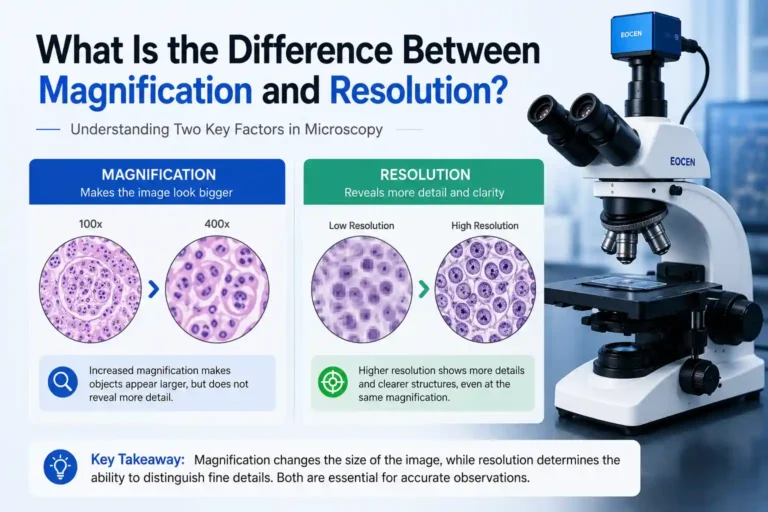
Magnification refers to how much larger an object appears when viewed through a microscope compared to its actual size.
For example:
- 10X magnification makes an object appear ten times larger.
- 40X magnification makes an object appear forty times larger.
- 100X magnification makes an object appear one hundred times larger.
Total magnification is typically calculated by multiplying:
Objective Lens × Eyepiece Lens
For example:
- 40X Objective × 10X Eyepiece = 400X Total Magnification
Magnification allows users to enlarge small structures that are invisible to the naked eye.
However, magnification alone does not determine image clarity.
What Is Resolution in a Microscope?
Microscope resolution explained simply: resolution is the ability to distinguish two closely spaced points as separate objects.
The higher the resolution, the more detail you can observe.
For example:
- Low resolution may cause two neighboring structures to appear as one blurred shape.
- High resolution allows those structures to be seen individually.
Resolution is influenced by:
- Numerical aperture (NA)
- Objective lens quality
- Illumination wavelength
- Optical design
- Sample preparation
In microscopy, resolution is often more important than magnification because it determines how much useful information can be extracted from an image.
Magnification vs Resolution: Key Differences
| Magnification | Resolution |
|---|---|
| Makes objects appear larger | Reveals fine details |
| Enlarges the image | Improves image clarity |
| Measured as X (40X, 100X, 1000X) | Measured in micrometers or nanometers |
| Easy to increase | Limited by optical physics |
| Does not guarantee better image quality | Directly affects image quality |
Understanding microscope resolution vs magnification helps users avoid choosing microscopes based solely on magnification specifications.
Why Higher Magnification Doesn’t Always Mean Better Image Quality
One of the biggest mistakes microscope buyers make is assuming more magnification automatically improves observations.
Imagine taking a low-resolution photograph and zooming in digitally.
The image becomes larger, but not sharper.
The same principle applies to microscopy.
Without sufficient optical resolution, increasing magnification creates a larger image without revealing additional detail.
This is known as empty magnification.
For most optical microscopes, useful magnification is limited by the resolving power of the optical system.
How Resolution Affects Microscope Image Quality
Microscope image quality depends heavily on resolution.
High-resolution optics allow users to observe:
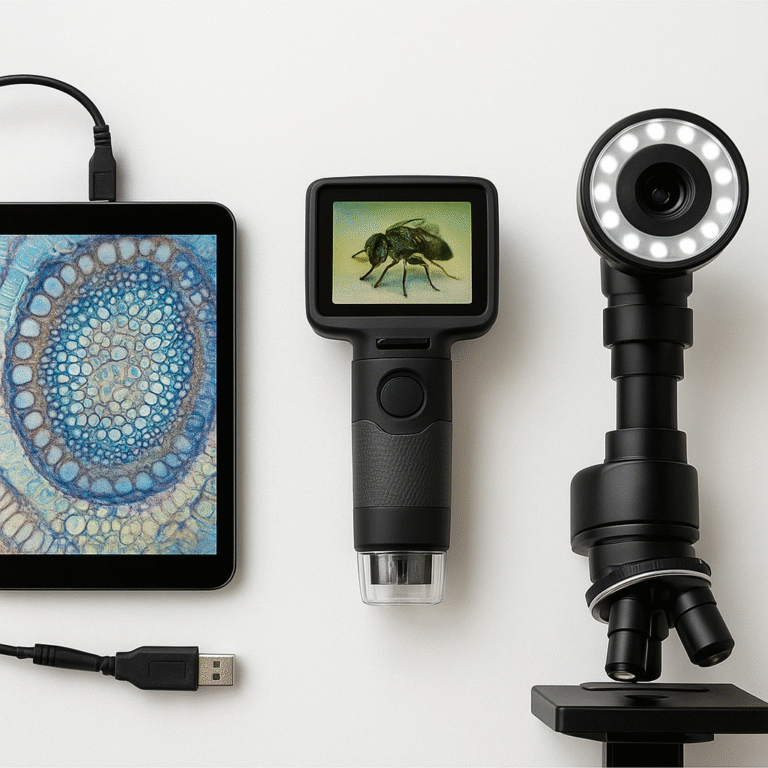
Modern digital microscopes combine high-resolution imaging with measurement and documentation tools, making them popular for research and industrial inspection.
- Cell structures
- Surface defects
- Material grain boundaries
- Semiconductor features
- Microorganisms
When resolution improves:
- Edges appear sharper
- Fine details become visible
- Contrast increases
- Measurements become more accurate
This is why professional microscopes prioritize optical quality and numerical aperture rather than simply advertising higher magnification.
Examples of Magnification and Resolution in Real Applications
Biological Microscopy
Biologists often require high resolution to observe:
- Cells
- Tissue structures
- Bacteria
- Organelles
In these applications, resolution is critical for identifying biological details accurately.
For laboratory observation and life science research, biological microscopes provide the optical performance required for clear specimen visualization
Industrial Inspection
Industrial inspectors use microscopes to detect:
- Surface scratches
- Manufacturing defects
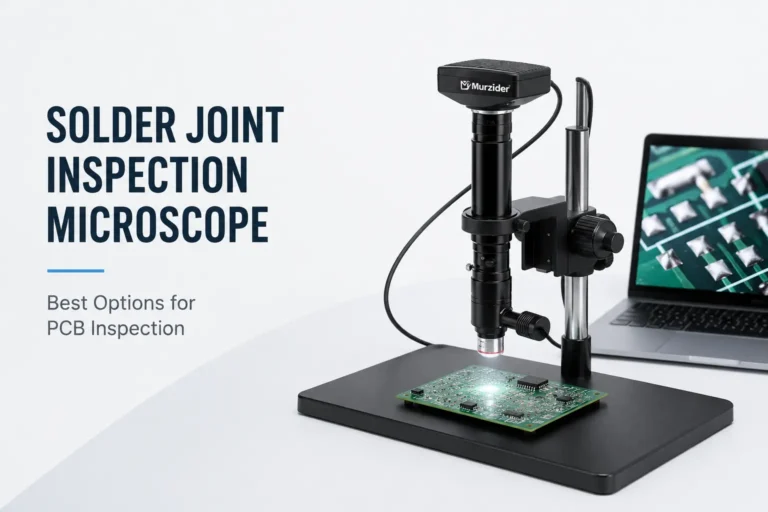
- PCB solder quality
- Component damage
A balance between magnification and resolution ensures reliable inspection results.
Semiconductor Analysis
Semiconductor engineers require extremely high resolution for:
- Wafer inspection
- Defect detection
- Failure analysis
- Chip packaging inspection
In advanced semiconductor applications, image clarity is often more important than magnification alone.
How to Choose the Right Balance Between Magnification and Resolution
When selecting a microscope, consider:
Your Application
Different tasks require different levels of detail.
Objective Lens Quality
High-quality objectives often improve resolution more than additional magnification.
Numerical Aperture
Higher NA generally provides better resolving power.
Camera Resolution
For digital microscopes, sensor quality also contributes to overall image quality.
The best microscope is not necessarily the one with the highest magnification, but the one that delivers the highest useful resolution for your application.
Frequently Asked Questions About Magnification and Resolution
Magnification makes an object appear larger, while resolution determines how much detail can be seen. A microscope can have high magnification but still produce a blurry image if its resolution is low.
For most microscopy applications, resolution is more important than magnification. Higher resolution reveals finer details, while excessive magnification without sufficient resolution only enlarges the image without improving clarity.
Yes. High magnification does not guarantee clear images. If the optical system lacks sufficient resolving power, the image may appear larger but not sharper, a phenomenon known as empty magnification.
Poor microscope image quality can result from low resolution, poor optics, incorrect illumination, dirty lenses, improper focus, or insufficient numerical aperture.
As magnification increases, optical limitations become more noticeable. If the microscope’s resolution cannot support the increased magnification, image sharpness decreases and fine details may become difficult to distinguish.
Resolution determines the smallest detail that can be distinguished in an image. Higher resolution produces sharper images, clearer structures, and more accurate observations.
Empty magnification occurs when a microscope enlarges an image beyond its resolving capability. The image becomes larger, but no additional detail is visible.
Microscope resolution can be improved by using higher-quality objective lenses, increasing numerical aperture, optimizing illumination, and ensuring proper specimen preparation.
In addition to magnification, consider resolution, numerical aperture, optical quality, illumination type, camera performance, and intended application.
The ideal magnification depends on the specimen. Most biological observations are performed between 40X and 1000X, but sufficient resolution is essential for meaningful image quality.
Recommended Microscope Solutions
Understanding magnification vs resolution is essential when selecting the right microscope. Whether you need a microscope for biological research, industrial inspection, or semiconductor analysis, choosing the correct optical system can significantly improve image quality and observation accuracy.
Conclusion
Understanding magnification vs resolution is essential for anyone using a microscope. While magnification enlarges objects, resolution determines how much meaningful detail can actually be observed.
Whether you’re performing biological research, industrial inspection, or semiconductor analysis, choosing a microscope with the right balance of magnification and resolution will result in better observations, higher image quality, and more accurate results.