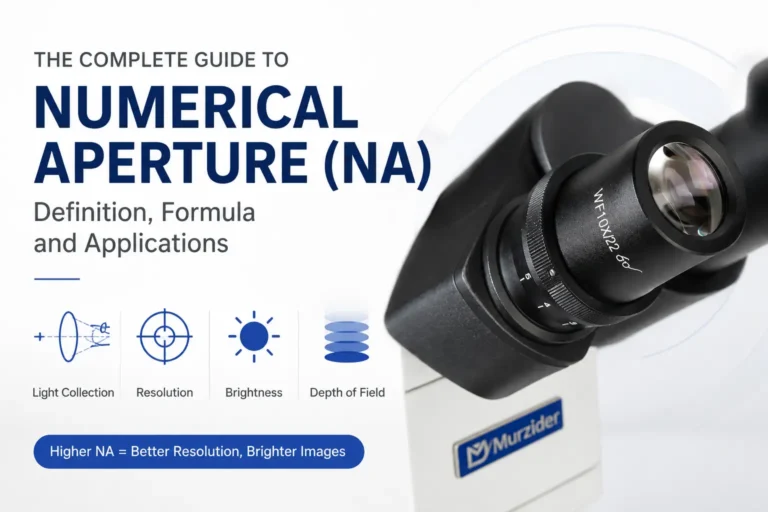
Numerical Aperture (NA) is a dimensionless number that characterizes the range of angles over which an optical system—such as a microscope objective, camera lens, or optical fiber—can accept or emit light.
In simple terms, NA measures an optical system’s ability to gather light and resolve fine details. A higher numerical aperture generally provides better resolution, brighter images, and improved optical performance.
What Is Numerical Aperture?
Numerical Aperture (NA) is one of the most important specifications in optics. It describes how efficiently an optical system collects light from a sample or delivers light to a target.
The concept was introduced by Ernst Abbe in 1873 while studying microscope resolution. Today, NA remains a fundamental parameter in microscopy, fiber optics, laser systems, semiconductor lithography, and photography.
In simple words:
Numerical Aperture is the “light-gathering power” of an optical system.
Think of a lens as a funnel collecting light. A larger funnel captures more light and more image information. Likewise, a higher NA allows an optical system to collect a wider cone of light rays, resulting in higher resolution and brighter images.
For microscope users, NA is often more important than magnification. A high-NA objective can reveal details that a higher-magnification but lower-NA objective cannot.
Related Reading:
What Is the Difference Between Magnification and Resolution?
How to Calculate Numerical Aperture
For microscope objectives and imaging lenses, numerical aperture is calculated using: NA=n×sin(θ)NA = n \times \sin(\theta)NA=n×sin(θ)
Where:
| Variable | Meaning |
|---|---|
| n | Refractive index of the medium |
| θ | Half-angle of the maximum light cone |
| NA | Numerical Aperture |
Common Refractive Index Values
| Medium | Refractive Index (n) |
|---|---|
| Air | 1.00 |
| Water | 1.33 |
| Immersion Oil | 1.515 |
Because immersion oil has a higher refractive index than air, oil immersion objectives can achieve much higher NA values than dry objectives.
Numerical Aperture Formula for Optical Fibers
In fiber optics, NA is calculated differently: NA=ncore2−ncladding2NA=\sqrt{n_{core}^{2}-n_{cladding}^{2}}NA=ncore2−ncladding2
Where:
- ncore = refractive index of the fiber core
- ncladding = refractive index of the cladding
A larger fiber NA allows light to enter from a wider range of angles, improving coupling efficiency.
Typical NA Values
Microscope Objectives
| Objective Type | Typical NA Range |
|---|---|
| 4× Dry | 0.10 |
| 10× Dry | 0.25–0.45 |
| 20× Dry | 0.40–0.75 |
| 40× Dry | 0.65–0.95 |
| 60× Water Immersion | 0.90–1.20 |
| 100× Oil Immersion | 1.00–1.40 |
Dry objectives are generally limited to approximately NA 0.95, while oil immersion objectives commonly reach NA 1.30–1.40.
Dry objectives are generally limited to approximately NA 0.95, while oil immersion objectives commonly reach NA 1.30–1.40.
Different objective lenses are designed to balance numerical aperture, magnification, working distance, and depth of field. Choosing the right objective depends on your application requirements.
Related Reading: How to Choose the Right Microscope Objective Lens
Optical Fibers
| Fiber Type | Typical NA |
|---|---|
| Single-Mode Fiber | 0.10–0.15 |
| Multimode Fiber | 0.20–0.30 |
| High-NA Specialty Fiber | 0.30+ |
Numerical Aperture vs Magnification
One of the most common misconceptions is that higher magnification automatically means better image quality.
In reality, numerical aperture often matters more.
| Feature | Numerical Aperture | Magnification |
|---|---|---|
| Determines Resolution | ✓ | |
| Determines Image Size | ✓ | |
| Affects Brightness | ✓ | |
| Improves Detail Visibility | ✓ | |
| Enlarges Objects | ✓ |
For example, a 40× objective with NA 0.95 may resolve more detail than a 100× objective with NA 0.65.
This is why optical engineers usually evaluate objective performance based on both magnification and NA, rather than magnification alone.
Why Numerical Aperture Matters
1. Resolution
Resolution is the ability to distinguish two closely spaced points.
According to Abbe’s diffraction limit: d=λ2NAd=\frac{\lambda}{2NA}d=2NAλ
As NA increases, the minimum resolvable distance decreases, allowing finer details to become visible.
Higher NA means:
- Sharper images
- Better detail recognition
- Improved microscopic analysis
2. Brightness
Higher NA allows more light to reach the detector or eyepiece.
This results in:
- Brighter images
- Better contrast
- Stronger fluorescence signals
For fluorescence microscopy, brightness increases dramatically as NA increases, making high-NA objectives essential for low-light imaging applications.
3. Depth of Field
The trade-off of higher NA is reduced depth of field.
| NA | Depth of Field |
|---|---|
| Low NA | Deeper focus |
| High NA | Shallower focus |
A high-NA objective provides excellent detail but requires more precise focusing because only a thin layer of the sample remains in focus.
Applications of Numerical Aperture
Microscopy
In biological and industrial microscopy, NA directly determines image quality.
High-NA objectives are commonly used for:
- Cell biology
- Pathology
- Fluorescence imaging
- Semiconductor inspection
- Materials analysis
Fiber Optics
NA defines the acceptance angle of an optical fiber.
A higher fiber NA:
- Accepts more incoming light
- Improves coupling efficiency
- Simplifies alignment
A lower NA helps reduce modal dispersion in long-distance communication systems.
Semiconductor Lithography
Modern semiconductor manufacturing relies on high-NA optical systems to print increasingly smaller circuit patterns onto silicon wafers.
Higher NA enables higher-resolution imaging and smaller feature sizes.
Laser Focusing
Numerical aperture determines the minimum achievable laser spot size.
Higher NA lenses create tighter focus points, improving:
- Laser cutting
- Laser engraving
- Optical storage systems
- Medical laser applications
Photography
In photography, the equivalent concept is the f-number (f/#).
A lower f-number corresponds to a higher numerical aperture and greater light-gathering ability.
Fast lenses such as f/1.4 or f/1.2 provide higher NA and better low-light performance.
How to Choose the Right NA
| Application | Recommended NA |
|---|---|
| Routine Biological Observation | 0.40–0.75 |
| Cell Imaging | 0.75–1.00 |
| Fluorescence Microscopy | 1.00–1.40 |
| Live Cell Imaging | 0.80–1.20 |
| Single-Mode Fiber Systems | 0.10–0.15 |
| Multimode Fiber Systems | 0.20–0.30 |
As a general rule:
- Choose lower NA for greater depth of field and easier focusing.
- Choose higher NA when maximum resolution and brightness are required.
Frequently Asked Questions
Numerical aperture describes how much light an optical system can collect. A higher NA means more light, higher resolution, and brighter images.
NA stands for Numerical Aperture, a dimensionless value that measures the light-gathering ability of lenses, microscope objectives, and optical fibers.
Yes. Oil immersion objectives use media with refractive indices greater than 1.0, allowing commercial objectives to achieve NA values up to approximately 1.4–1.49.
NA = √(n²core − n²cladding)
For microscope objectives:
NA = n × sin(θ)
For optical fibers:
Most microscope objectives range from 0.10 to 1.40, while camera lenses typically operate at lower equivalent NA values.
Not always. Higher NA improves resolution and brightness but reduces depth of field and working distance. The best NA depends on the application.
Expert Tip from Murzider
At Murzider, we recommend evaluating both magnification and numerical aperture when selecting a microscope objective. While magnification determines image size, numerical aperture has a greater impact on resolution, brightness, and overall image quality. Understanding both parameters helps users choose the most suitable microscope for biological research, industrial inspection, and educational applications.
Conclusion
Numerical Aperture (NA) is one of the most important parameters in optical engineering because it determines how efficiently an optical system collects light and resolves detail.
The key takeaway is simple:
- Higher NA improves resolution.
- Higher NA increases image brightness.
- Higher NA reduces depth of field.
Whether you are choosing a microscope objective, designing a fiber optic system, or evaluating a lens, understanding numerical aperture will help you make better optical decisions.