Quick Answer
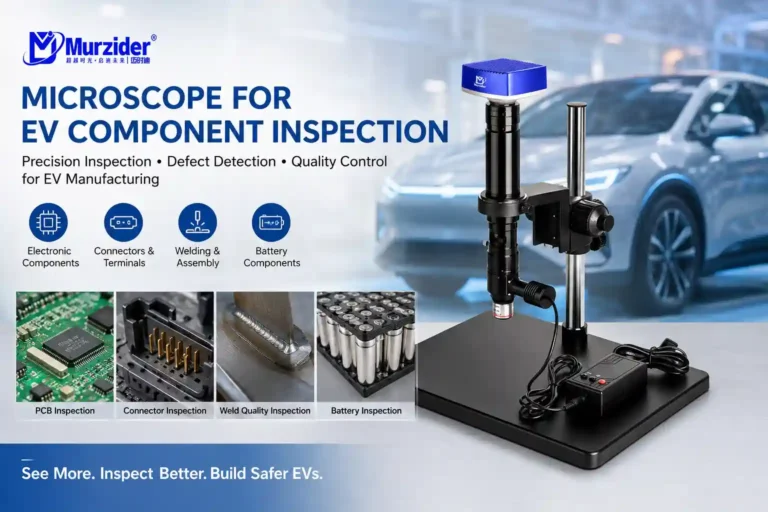
The rapid growth of the electric vehicle industry has significantly increased the demand for precision quality control equipment. An EV component inspection microscope has become an essential tool for manufacturers to detect tiny defects, improve production quality, and ensure the reliability of critical EV components throughout the manufacturing process.
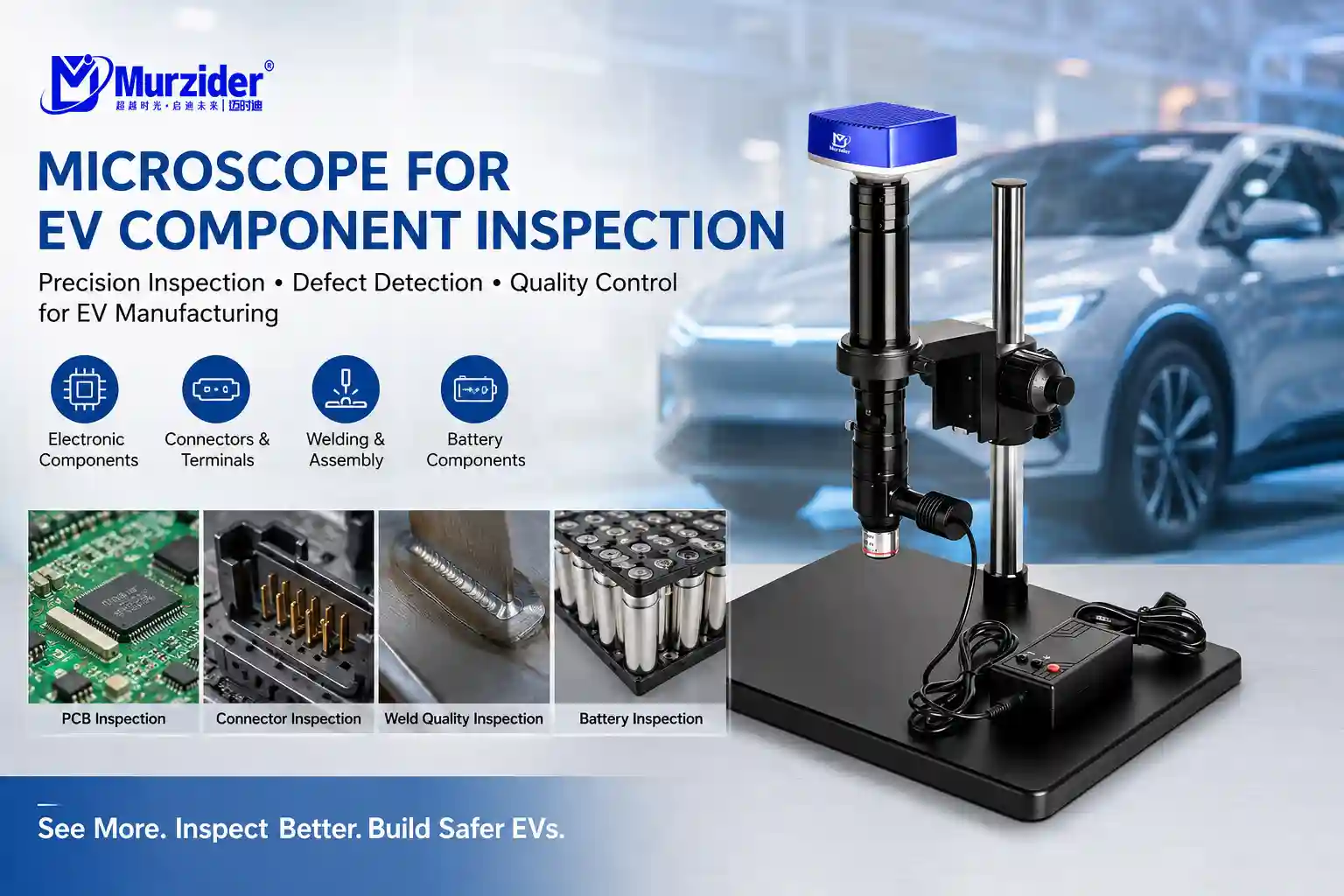
The Rapid Growth of EV Manufacturing Increases the Need for Precision Inspection
The global electric vehicle industry continues to expand at an unprecedented pace. Driven by technological innovation, environmental regulations, and growing consumer demand, EV manufacturers are under increasing pressure to deliver higher quality products while maintaining production efficiency.
As EV components become smaller, more sophisticated, and more integrated, traditional visual inspection methods are no longer sufficient. Tiny cracks, welding defects, contamination, and assembly errors can significantly affect product performance and vehicle safety.
For this reason, the electric vehicle inspection microscope has become a standard tool in modern manufacturing facilities. By providing high-resolution imaging and precise observation capabilities, it enables manufacturers to identify defects before products move to the next production stage.
This guide explores key EV inspection applications, common defects, microscope advantages, and how to select the right inspection solution for your production environment.
Booming EV Industry Drives Demand for Precision Inspection Microscopes
Quality Control Standards in Modern EV Manufacturing
Electric vehicles contain thousands of components that must meet strict quality and safety requirements. From power electronics and battery systems to sensors and connectors, even minor manufacturing defects can lead to performance issues or costly product recalls.
To maintain consistent quality, manufacturers implement multi-stage inspection processes throughout production. A professional EV manufacturing microscope allows inspectors to verify component integrity, dimensional accuracy, and assembly quality with greater precision than conventional inspection tools.
Why General Microscopes Fail EV Component Testing
Many standard microscopes are designed for laboratory observation rather than industrial inspection.
In contrast, EV production environments require:
- Continuous operation
- Large working distances
- Stable imaging performance
- Ergonomic operation
- Image documentation capabilities
A dedicated electric vehicle inspection microscope is specifically designed to meet these industrial requirements, making it far more suitable for factory-based quality control applications.
Key EV Components That Require Microscope Inspection
Microscopic inspection is used throughout the EV manufacturing process to ensure component reliability and safety.
Power System Components
Electric motors, battery management systems, power modules, and inverter assemblies all require detailed inspection during production.
Microscopes help detect machining defects, surface damage, and assembly inconsistencies that could affect system performance.
Automotive Electronic Components
Modern EVs contain numerous electronic modules, including:
- Control boards
- Sensors
- Cameras
- Power management systems
A professional EV manufacturing microscope helps identify soldering defects, contamination, and micro-level component damage before final assembly.
Precision Structural Components
Many EV parts are manufactured using precision machining, die casting, or injection molding processes.
Microscopic inspection helps verify:
- Surface quality
- Dimensional consistency
- Burr removal
- Structural integrity
Wiring Harnesses and Connectors
Electrical connectors play a critical role in vehicle safety and system reliability.
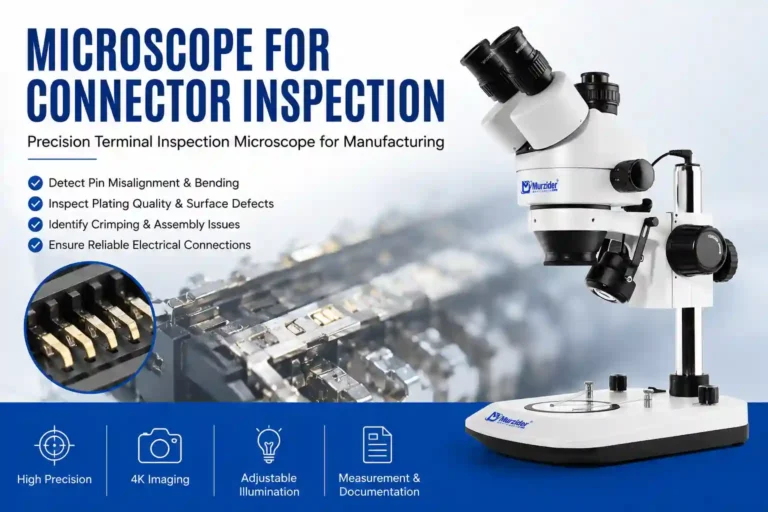
Manufacturers frequently use a Connector Inspection Microscope to inspect terminal alignment, plating quality, pin integrity, and crimping performance before installation.
Electrical connectors are critical for vehicle safety and signal transmission. For a detailed overview of connector inspection applications and quality control methods, read our Microscope for Connector Inspection guide.
Main Defects Detected by Electric Vehicle Inspection Microscope
Quality control teams rely on microscopy to identify defects that are difficult or impossible to detect with the naked eye.
Surface Scratches, Cracks, and Burrs
Microscopes can quickly reveal:
- Surface scratches
- Edge burrs
- Micro-cracks
- Coating damage
These defects may compromise component performance and durability.
Welding and Assembly Flaws
Many EV components involve welding and precision assembly operations.
Inspection helps identify:
- Incomplete welds
- Welding cracks
- Poor alignment
- Assembly gaps
Material Impurities and Dimensional Deviations
Microscopic analysis can detect:
- Foreign particles
- Material contamination
- Manufacturing deviations
- Dimensional inconsistencies
Hidden Defects Affecting Vehicle Safety
Certain defects may remain invisible during routine inspection but can impact long-term reliability.
A professional electric vehicle inspection microscope provides the magnification and clarity necessary to identify these hidden risks before products reach the market.
Core Advantages of Our EV Manufacturing Microscope
At Murzider, we develop industrial microscopy solutions specifically designed for demanding inspection environments.
High Magnification and High-Definition Imaging
Our systems provide sharp, detailed images that allow operators to inspect complex EV components with confidence.
Reliable Performance for Continuous Production
Industrial production lines require equipment that can operate consistently for extended periods.
Murzider microscopes are built for durability and long-term reliability in manufacturing environments.
Image Capture and Quality Traceability
Many quality management systems require complete inspection records.
Our microscopes support image capture, storage, measurement, and documentation to simplify quality traceability.
Many manufacturers use an Industrial Digital Microscope to capture images, document defects, and maintain inspection records throughout EV production.
Easy Operation for Inspection Teams
User-friendly controls and ergonomic designs help improve inspection efficiency while reducing operator fatigue.
Matching Inspection Solutions for New Energy Production Lines
The new energy industry relies on a complete inspection ecosystem rather than a single inspection tool.
Combine with Battery Inspection Microscope for Full New Energy Testing
Battery manufacturing is one of the most important stages in EV production.
Many manufacturers combine a Battery Inspection Microscope with EV component inspection systems to ensure complete quality control from battery cells to final vehicle assemblies.
Battery quality directly affects vehicle performance and safety. Learn more about defect detection, weld inspection, and quality control in our Microscope for Battery Inspection guide.
One-Stop Inspection Solutions for EV, Battery, and Connector Manufacturing
Murzider provides inspection solutions covering:
- EV components
- Lithium batteries
- Electrical connectors
- Precision electronic assemblies
This integrated approach helps manufacturers standardize quality control procedures across multiple production processes.
Custom Solutions for Different Production Processes
Every factory has unique inspection requirements.
Our engineering team can recommend customized microscopy solutions based on production volume, component size, inspection targets, and workflow requirements.
How to Select a Suitable Microscope for EV Component Inspection
Choosing the right microscope depends on several key factors.
Inspection Object and Magnification Requirements
Different components require different magnification levels.
For example:
| Inspection Application | Recommended Microscope |
|---|---|
| Connector Inspection | Stereo Microscope |
| Electronic Assembly Inspection | Industrial Digital Microscope |
| Material Analysis | Metallurgical Microscope |
| Precision Structural Components | Stereo Microscope |
Production Line or Laboratory Environment
Production-line inspection often requires robust industrial systems, while laboratory analysis may prioritize higher magnification and advanced imaging features.
Durability and Long-Term Support
Industrial inspection equipment represents a long-term investment.
Manufacturers should consider:
- Product reliability
- Technical support
- Upgrade options
- Spare parts availability
Choosing an experienced microscopy supplier can significantly reduce maintenance costs and downtime.
Conclusion
As electric vehicle manufacturing continues to evolve, precision inspection plays an increasingly important role in ensuring product quality, production efficiency, and long-term reliability. A professional electric vehicle inspection microscope helps manufacturers identify defects early, improve quality control processes, and meet the growing demands of modern EV production.
At Murzider, we provide advanced microscopy solutions for EV component inspection, battery manufacturing, connector testing, and industrial quality control. Whether you need inspection equipment for production lines or R&D applications, our team can help you find the right solution for your manufacturing requirements.
Need help selecting the right microscope for your EV inspection application? Explore Murzider’s professional microscopy solutions or contact our team for expert guidance.
Frequently Asked Questions
An electric vehicle inspection microscope is professional industrial equipment used to detect tiny defects on EV components. It helps ensure products meet strict manufacturing standards while reducing defect rates and improving quality control.
EV components are becoming increasingly compact and complex. Standard visual inspection methods often cannot detect hidden cracks, burrs, contamination, or welding flaws. A dedicated EV manufacturing microscope provides the precision needed for reliable inspection.
Microscopes are widely used for inspecting electronic assemblies, power components, structural parts, sensors, wiring harnesses, and connectors. They are also commonly used alongside battery inspection systems as part of a complete new energy quality control process.
Yes. Industrial EV inspection microscopes are designed for continuous operation and can easily adapt to large-scale manufacturing environments.
Absolutely. It can be integrated with battery inspection microscopes and connector inspection microscopes to create a comprehensive inspection system across the entire new energy manufacturing supply chain.