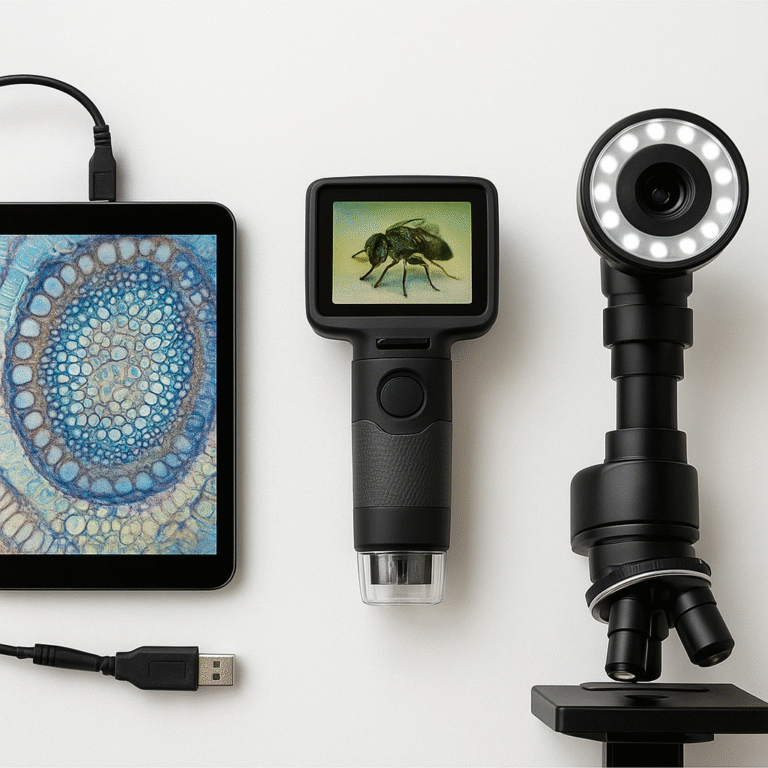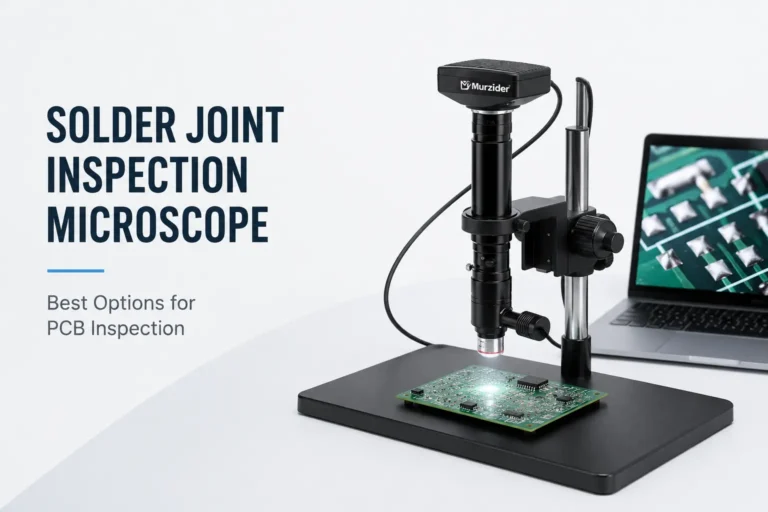
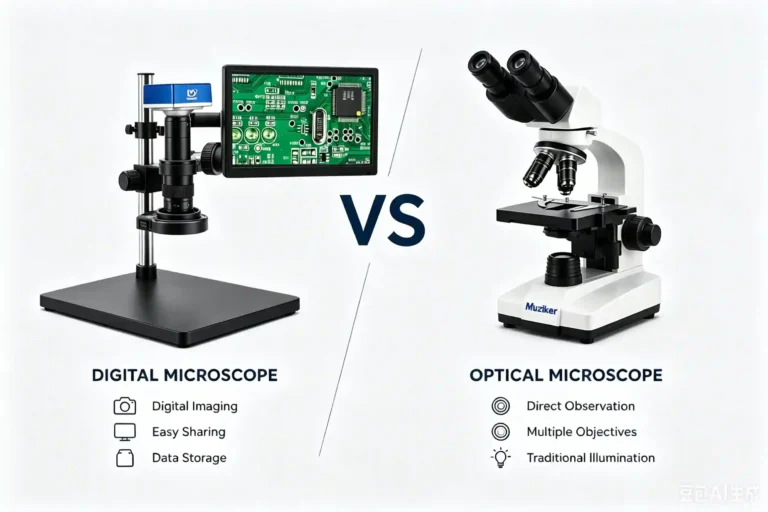
Choosing between a digital microscope vs optical microscope is one of the most common challenges faced by engineers, laboratory technicians, quality inspectors, educators, and researchers.
While both microscope types are designed to magnify and analyze small objects, they differ significantly in image acquisition, workflow efficiency, documentation capabilities, ergonomics, and long-term value.
As industries increasingly adopt digital inspection processes and traceability requirements become more demanding, understanding the strengths and limitations of each microscope system is essential.
This guide provides a comprehensive comparison of digital microscopes and optical microscopes, helping you determine which solution best matches your application.
What Is an Optical Microscope?
An optical microscope uses lenses and visible light to magnify specimens. Users observe samples directly through eyepieces, making it one of the oldest and most widely used microscopy technologies.
Optical microscopes are commonly used in:
- Biological laboratories
- Medical research
- Educational institutions
- Metallurgical analysis
- Material science
- Industrial inspection
Advantages of Optical Microscopes
- High optical resolution
- Natural color reproduction
- True real-time observation
- Wide magnification range
- Lower initial investment
- Durable and reliable design
Limitations
- Requires manual image capture
- Difficult to share observations in real time
- Extended eyepiece use may cause eye strain
- Limited documentation capabilities
What Is a Digital Microscope?
A digital microscope uses an integrated camera sensor to capture images and display them on a monitor or computer screen.
Unlike traditional microscopes, users view samples digitally rather than directly through eyepieces.
Digital microscopes are widely used in industrial inspection, especially in digital microscope vs optical microscope comparisons for manufacturing environments.
- PCB inspection
- Electronics manufacturing
- Semiconductor inspection
- Aerospace quality control
- Medical device inspection
- Failure analysis
Advantages of Digital Microscopes
- Large-screen viewing
- Integrated image capture
- Video recording
- Measurement software
- Easy documentation
- Remote collaboration
- Reduced operator fatigue
Limitations
- Higher upfront cost
- Software management requirements
- Greater system complexity
- Potential image processing latency in some systems
Digital Microscope vs Optical Microscope: Side-by-Side Comparison
| Feature | Digital Microscope | Optical Microscope |
|---|---|---|
| Viewing Method | Monitor Display | Eyepiece Viewing |
| Image Capture | Built-in | External Camera Required |
| Documentation | Excellent | Limited |
| Collaboration | Excellent | Limited |
| Operator Comfort | High | Moderate |
| Resolution | Sensor Dependent | Lens Dependent |
| Data Storage | Automatic | Manual |
| Regulatory Compliance | Excellent | Basic |
| Initial Cost | Higher | Lower |
| Maintenance | Moderate | Low |
1. Resolution and Image Quality
When it comes to resolution and image quality, optical microscopes have traditionally held an edge.
For a deeper understanding of optical performance, see Magnification vs Resolution.
Traditionally, optical microscopes have maintained an advantage in pure optical resolution. High-quality objectives and precision optical systems can produce exceptionally sharp and detailed images.
However, modern digital microscopes have improved dramatically thanks to:
- High-resolution CMOS sensors
- Advanced image processing
- HDR imaging
- Real-time enhancement algorithms
For most industrial inspection applications, digital microscopes now provide image quality that exceeds operational requirements.
Best Choice
Optical Microscope
- Biological research
- Histology
- Laboratory analysis
Digital Microscope
- PCB inspection
- Electronics manufacturing
- Quality control documentation
2. Magnification Range and Flexibility
Optical microscopes achieve magnification through interchangeable objective lenses and eyepieces.
Digital microscopes often feature:
- Motorized zoom systems
- Continuous magnification adjustment
- Digital enhancement tools
- On-screen measurement functions
Many industrial digital microscopes allow users to zoom from macro-level inspections to micro-level analysis without changing lenses.
Practical Benefit
For manufacturing environments where inspection speed is critical, digital microscopes often provide a more efficient workflow.
3. Image Capture and Documentation
One of the biggest advantages of a digital microscope is documentation.
Digital systems allow operators to:
- Capture images instantly
- Record videos
- Add annotations
- Generate inspection reports
- Store inspection records
Optical microscopes usually require an external camera system, increasing both cost and workflow complexity.
Why Documentation Matters
Industries such as:
- Medical devices
- Aerospace
- Automotive
- Electronics manufacturing
must maintain traceable inspection records for audits and quality assurance.
In these environments, digital microscopes offer a significant advantage.
4. Connectivity and Collaboration
Modern manufacturing increasingly relies on connected workflows.
Digital microscopes support:
- USB connectivity
- HDMI output
- Ethernet integration
- Wi-Fi sharing
- Remote collaboration
Engineers located in different facilities can review the same inspection images simultaneously.
Optical microscopes generally lack this level of connectivity without additional hardware.
5. Ergonomics and Operator Comfort
Operator fatigue is often overlooked when evaluating microscopy systems.
Optical Microscope Challenges
Extended eyepiece use may lead to:
- Neck strain
- Eye fatigue
- Poor posture
- Reduced productivity
Digital Microscope Benefits
Monitor-based viewing enables:
- Natural posture
- Reduced eye strain
- Easier training
- Improved comfort during long inspections
For quality control teams performing inspections for several hours each day, ergonomics can significantly impact productivity.
6. Data Management and Traceability
Modern quality systems require more than visual inspection.
Digital microscopes support:
- Automated image storage
- Inspection history tracking
- Cloud-based archiving
- Audit trail generation
This capability is particularly valuable for organizations complying with:
- ISO 13485
- FDA regulations
- Aerospace quality standards
- Automotive quality systems
Optical microscopes typically rely on manual documentation processes, increasing the risk of errors.
7. Cost, Maintenance, and Long-Term Value
Optical Microscopes
Advantages:
- Lower acquisition cost
- Simple maintenance
- Long service life
Best for:
- Schools
- Basic laboratories
- Low-volume inspections
Digital Microscopes
Advantages:
- Higher efficiency
- Reduced inspection time
- Better traceability
- Improved collaboration
Although digital systems require a larger initial investment, many manufacturers achieve a lower total cost of ownership through productivity gains.
When an Optical Microscope Is the Better Choice
Choose an optical microscope if you need:
✓ Biological observation
✓ Histology analysis
✓ Educational laboratory work
✓ Low-volume inspection
✓ Simple workflows
✓ Budget-conscious solutions
✓ Maximum optical clarity
When a Digital Microscope Is the Better Choice
Choose a digital microscope if you need:
✓ PCB inspection
✓ Semiconductor analysis
✓ High-volume quality control
✓ Inspection documentation
✓ Regulatory compliance
✓ Remote collaboration
✓ Measurement and reporting
✓ Long-duration inspections
How to Decide
When selecting between a digital microscope vs optical microscope, evaluate three critical factors:
1. Application Complexity
Are you inspecting:
- Microchips?
- PCB solder joints?
- Medical devices?
- Precision-machined components?
Complex inspections generally benefit from digital systems.
2. Workflow Requirements
High-volume inspection environments often justify investment in digital microscopes through efficiency improvements.
3. Documentation and Compliance
If your organization requires:
- Inspection reports
- Audit trails
- Traceability records
a digital microscope is typically the better solution.
Why Choose Murzider Microscopes?
Murzider is a professional manufacturer specializing in advanced microscopy solutions for industrial, educational, and scientific applications.
Our product portfolio includes:
- Fluorescence Microscopes
- Biological Microscopes
- Industrial Digital Microscopes
- Metallurgical Microscopes
- Polarizing Microscopes
- Stereo Microscopes
The Murzider Advantage
✓ Direct Factory Manufacturing
✓ OEM & ODM Support
✓ Global Export Experience
✓ Strict Quality Control
✓ Competitive Factory Pricing
✓ Professional Technical Support
✓ Custom Microscope Solutions
Whether you need a microscope for PCB inspection, electronics manufacturing, laboratory research, or industrial quality control, Murzider delivers reliable and cost-effective solutions designed for professional performance.
FAQ
Not always. Digital microscopes are superior for documentation, collaboration, and industrial inspection, while optical microscopes often provide better direct optical viewing for biological applications.
Digital microscopes and stereo microscopes are typically preferred because they provide large-screen viewing, measurement capabilities, and inspection documentation.
For measurement, documentation, and repeatability, digital microscopes often provide greater consistency through software-assisted analysis.
Digital microscopes improve inspection efficiency, traceability, collaboration, and compliance with modern quality standards.
For many industrial applications, yes. However, biological and advanced laboratory research often still rely on traditional optical microscope systems.