Can a Microscope Really Reach 2000x Magnification?
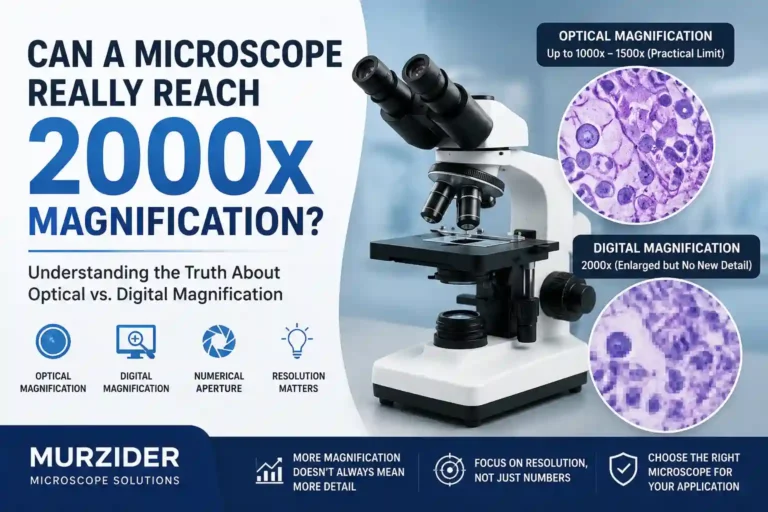
2000x microscope magnification is one of the most misunderstood topics in microscopy. Many buyers think adding a higher-resolution camera or a larger monitor can achieve true 2000× magnification. In reality, optical magnification and digital magnification are not the same—digital zoom enlarges the image but does not reveal new details.
One of the most common questions microscope buyers ask is:
“How can I make my microscope reach 2000x magnification?”
At Murzider, we regularly receive inquiries from customers asking whether a microscope can be upgraded to 2000× simply by adding a higher-resolution camera or a larger display. This question highlights one of the most common misconceptions in microscopy: confusing digital magnification with true optical magnification.
As a manufacturer specializing in biological microscopes, stereo microscopes, metallurgical microscopes, fluorescence microscopes, and industrial digital microscopes, we believe understanding the science behind magnification is essential for choosing the right microscope system.
Optical Magnification vs. Digital Magnification
Before discussing 2000x magnification, it is important to distinguish between two very different concepts. If you’re unsure how digital and optical systems differ, read our Digital Microscope vs Optical Microscope guide.
What Is Optical Magnification?
Optical magnification is produced by the microscope’s optical system, mainly through the combination of:
- Objective lens
- Eyepiece lens
For example:
- 100× objective lens
- 10× eyepiece
Produces:
100 × 10 = 1000× optical magnification
This magnification is created by actual optical components and can reveal additional details when supported by sufficient resolution.
What Is Digital Magnification?
Digital magnification occurs after the image has already been captured.
Examples include:
- Zooming in on a monitor
- Enlarging an image using software
- Displaying microscope images on larger screens
- Cropping and scaling images
Digital enlargement only stretches existing pixels.
If the original image lacks detail, enlarging it simply makes the pixels bigger—not sharper.
Think of it like zooming into a low-resolution photo on your smartphone. The image becomes larger, but no new information appears.
Why 2000x Magnification Is Often Misleading
Many microscope advertisements promote magnifications such as:
- 2000×
- 2500×
- 3000×
In many cases, these numbers are achieved through digital scaling rather than true optical performance.
A microscope may display an image that appears twice as large on a screen, but the actual optical resolution remains unchanged.
As a result, users often see:
- Larger images
- More visible pixels
- No additional specimen details
This phenomenon is known as empty magnification.
The Physics Behind Microscope Limits: The Abbe Diffraction Limit
The reason optical magnification cannot increase indefinitely comes from fundamental physics.
In 1873, German physicist Ernst Abbe established the diffraction limit of optical microscopes.
The Abbe equation is: d=λ2NAd=\frac{\lambda}{2NA}d=2NAλ
Where:
- d = smallest resolvable distance
- λ = wavelength of light
- NA = numerical aperture of the objective lens. Learn more in our guide: What Is Numerical Aperture (NA)?
This equation determines the maximum detail that a light microscope can resolve.
The Resolution Limit of Visible Light
Visible light wavelengths range approximately from:
- 400 nm to 700 nm
Even with premium oil-immersion objectives and excellent optics, the practical resolution limit of a conventional light microscope is approximately:
0.2 micrometers (200 nm)
Once this resolution limit is reached, increasing magnification further cannot reveal additional information.
You are simply enlarging the same image.
Why Most Optical Microscopes Peak Around 1000x–1500x
Microscope manufacturers generally consider:
1000x to 1500x optical magnification
to be the practical upper limit for standard visible-light microscopy.
A typical high-end biological microscope may use:
| Component | Magnification |
|---|---|
| Eyepiece | 10× |
| Objective | 100× Oil |
| Total Optical Magnification | 1000× |
Some systems use:
- 15× eyepieces
- 100× objectives
to achieve:
1500× optical magnification
Beyond this point, image enlargement usually exceeds the resolving capability of visible light.
The result is larger images without additional detail.
Can a Higher-Resolution Camera Increase Magnification?
This is another common misunderstanding.
A 20MP camera does not automatically provide more optical magnification than a 5MP camera.
What a higher-resolution camera can do is:
✓ Capture more image pixels
✓ Improve image recording quality
✓ Allow moderate digital zoom with less degradation
✓ Enhance measurement and documentation
However, it cannot:
✗ Break the diffraction limit
✗ Increase optical resolution
✗ Turn a 1000× microscope into a true 2000× microscope
The optical system remains the limiting factor. If you’re experiencing blurry images, poor contrast, or focusing issues, check out our Common Microscope Problems and Troubleshooting Guide.
Real-World Factors That Limit High Magnification
Even before reaching theoretical optical limits, several practical issues affect image quality.
Illumination
Higher magnification requires more light.
Insufficient illumination often causes:
- Dim images
- Low contrast
- Reduced clarity
Numerical Aperture
A high-NA objective is often more important than simply increasing magnification.
Higher NA improves:
- Resolution
- Brightness
- Image detail
Working Distance
As magnification increases:
- Working distance decreases
- Focusing becomes more difficult
- Sample preparation becomes more critical
Optical Compatibility
Achieving maximum performance requires proper matching between:
- Objectives
- Eyepieces
- Camera adapters
- Sensor sizes
- Tube lenses
Poor compatibility can reduce image quality even with expensive components.
What Should You Focus on Instead of 2000x Magnification?
At Murzider, we recommend evaluating a microscope based on optical performance rather than advertised magnification numbers. Factors such as objective quality, numerical aperture, illumination design, and camera compatibility often have a much greater impact on image quality than simply pursuing higher magnification.
Our microscope systems are designed with matched optical components to ensure that magnification, resolution, and imaging performance remain balanced for laboratory, educational, industrial inspection, and research applications.
If you’re comparing microscope specifications and aren’t sure which model best fits your application, our Microscope Buying Guide explains how to choose the right microscope based on sample type, magnification requirements, imaging needs, and budget.
Rather than chasing higher magnification numbers, buyers should evaluate:
Resolution
The most important indicator of microscope performance.
Numerical Aperture (NA)
Higher NA generally means better detail.
Optical Quality
Premium objectives often outperform cheaper lenses even at the same magnification.
Camera Quality
Useful for documentation and analysis, not for increasing optical resolution.
Lighting System
Good illumination dramatically improves image quality.
Recommended Applications for Different Magnification Ranges
| Magnification | Typical Applications |
|---|---|
| 40×–100× | Educational observation, insects, plants |
| 100×–400× | Cell structures, biological samples |
| 400×–1000× | Bacteria, blood cells, microbiology |
| 1000×–1500× | Advanced laboratory research |
| Above 1500× | Usually empty magnification in light microscopy |
FAQ
Yes, digitally. However, digital enlargement does not improve optical resolution and will not reveal additional specimen details.
In most cases, no. Beyond approximately 1000×–1500×, the image becomes larger without providing more information.
Because digital zoom enlarges existing pixels rather than capturing new optical details.
Empty magnification occurs when image size increases without a corresponding increase in resolution or detail.
For structures beyond the capabilities of visible-light microscopy, consider:
Electron microscopes
Confocal microscopes
Super-resolution microscopy systems
Optical magnification is produced by the microscope’s lenses and can reveal additional specimen details when supported by sufficient resolution. Digital magnification enlarges an image after it has been captured and does not increase optical resolution.
Recommended External References
Why Professionals Choose Murzider
Whether you are inspecting PCBs, observing biological specimens, conducting metallurgical analysis, or performing scientific research, selecting the right microscope is far more important than chasing unrealistic magnification claims.
Murzider provides a wide range of microscope solutions including:
- Biological Microscopes
- Stereo Microscopes
- Industrial Digital Microscopes
- Metallurgical Microscopes
- Fluorescence Microscopes
- Polarizing Microscopes
By focusing on optical quality, resolution, and system compatibility, our microscope solutions help users obtain clear and reliable images without relying on misleading digital magnification claims.
Conclusion
When discussing 2000x microscope magnification, it is essential to separate marketing claims from optical reality.
A larger image does not necessarily mean more detail. The performance of a microscope is ultimately determined by its optical resolution, not by how large the image appears on a monitor.
Due to the Abbe diffraction limit, conventional visible-light microscopes generally reach their practical optical limit between 1000× and 1500× magnification. Beyond that point, additional enlargement is typically digital scaling that produces empty magnification rather than new information.
Instead of focusing solely on magnification numbers, users should prioritize resolution, numerical aperture, optical quality, illumination, and system compatibility to achieve the best imaging results.