Quick Answer
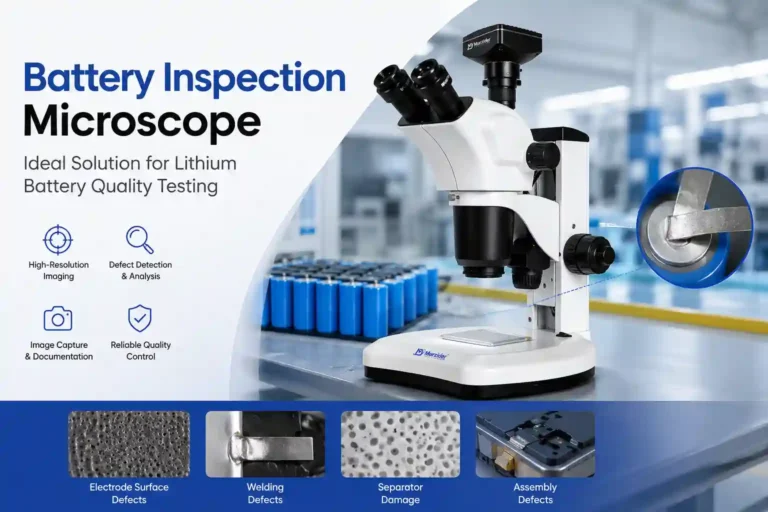
A battery inspection microscope is an essential quality control tool used throughout lithium battery manufacturing. It helps detect electrode defects, welding imperfections, surface contamination, assembly errors, and other microscopic issues that can affect battery safety and performance. For modern production lines, a professional lithium battery inspection microscope provides accurate defect detection, documentation, and process verification to ensure consistent product quality.
The Growing Demand for Microscopes in Lithium Battery Inspection
The rapid growth of electric vehicles, renewable energy storage systems, and portable electronics has significantly increased the demand for high-quality lithium batteries. As manufacturers expand production capacity, maintaining strict quality standards while minimizing defects has become more challenging than ever.
In this environment, a battery inspection microscope has become a critical quality assurance tool. Even microscopic defects can affect battery performance, lifespan, charging efficiency, and safety. Manufacturers increasingly rely on advanced microscopy systems to inspect battery components throughout the production process.
Unlike general-purpose inspection equipment, a dedicated industrial microscope for battery testing provides the magnification, image clarity, and observation flexibility required for modern lithium battery manufacturing environments.
Key Defects Detected by a Dedicated Battery Inspection Microscope
Battery production involves multiple precision manufacturing processes. We need to spot potential defects at every production stage before products go to market.
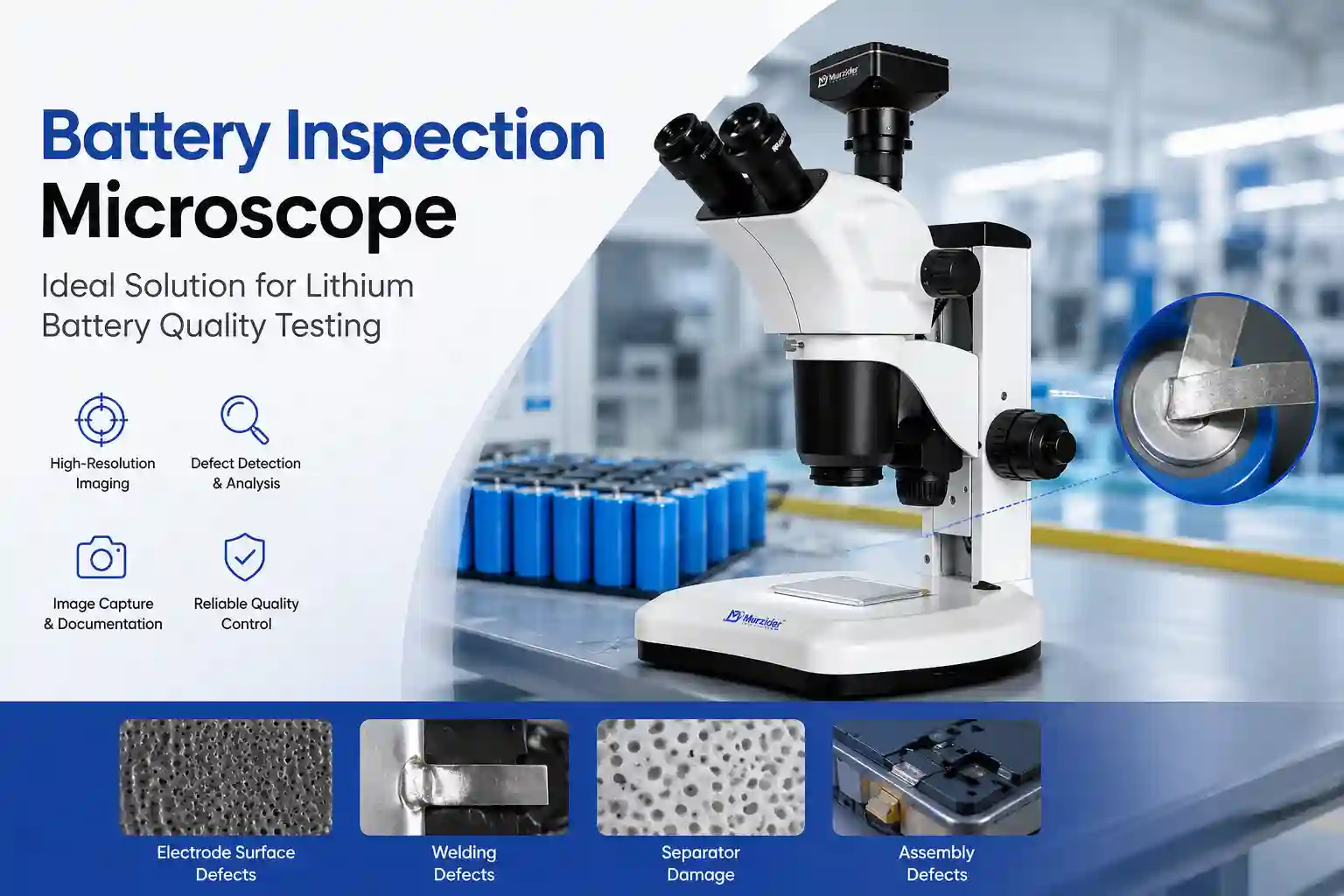
A professional lithium battery microscope can help detect:
Electrode Surface Defects
Electrode coating irregularities can directly affect battery performance and charging efficiency. Common issues include:
- Uneven coating thickness
- Scratches and abrasions
- Coating contamination
- Material separation
Welding Defects
Battery tabs and connectors require precise welding. Microscopic inspection helps identify:
- Welding burrs
- Incomplete welds
- Cracks
- Porosity
Separator Damage
The separator is a critical safety component inside lithium batteries. Inspection can reveal:
- Tears
- Pinholes
- Deformation
- Foreign particle contamination
Assembly Defects
Manufacturers also use a battery defect detection microscope to inspect:
- Misaligned components
- Gap inconsistencies
- Surface contamination
- Packaging defects
Early detection of these issues helps reduce scrap rates and improve production efficiency.
Battery Manufacturing Stages That Require Microscopic Inspection
Microscopes play a vital role throughout the entire lithium battery production process.
Electrode Coating Inspection
Inspect coating uniformity, scratches, contamination, and edge defects before cell assembly.
Tab Welding Inspection
Examine weld quality, burrs, cracks, and incomplete welds that may affect electrical conductivity.
For detailed weld observation, many manufacturers rely on a Stereo Microscope because it provides excellent depth perception and working distance during inspection.
Cell Assembly Inspection
Verify alignment, separator condition, and assembly precision during lithium cell production.
Module and Pack Inspection
Inspect busbars, connectors, and structural components before final assembly.
Final Quality Control
Perform sampling inspections to ensure batteries meet manufacturing specifications before shipment.
Core Advantages of Our Industrial Microscope for Battery Testing
At Murzider, we design professional microscopy solutions for industrial inspection environments where accuracy, reliability, and efficiency are essential.
High-Resolution Imaging
Our battery inspection microscope systems provide sharp image quality and excellent depth perception, allowing operators to observe tiny defects with confidence.
Flexible Magnification Options
Different battery manufacturing stages require different levels of magnification. Murzider microscopes support a wide range of inspection requirements, from general assembly observation to detailed defect analysis.
Ergonomic Design for Continuous Operation
Production-line inspections often require long working hours. We design our systems to boost operator comfort and streamline workflow integration.
Image Capture and Documentation
Many production facilities use an Industrial Digital Microscope to capture inspection images, document defects, and maintain quality records.
Many manufacturers prefer an Industrial Digital Microscope for image recording, defect analysis, quality reporting, and traceability management.
Stable Performance in Industrial Environments
Unlike laboratory-only equipment, our industrial microscopy solutions are engineered to perform reliably in demanding manufacturing conditions.
Recommended Microscope Types for Battery Inspection
| Inspection Task | Recommended Microscope |
|---|---|
| Electrode Inspection | Stereo Microscope |
| Tab Welding Inspection | Stereo Microscope |
| Battery Cell Assembly | Stereo Microscope |
| Quality Documentation | Industrial Digital Microscope |
| Material Analysis | Metallurgical Microscope |
| Failure Analysis | Metallurgical Microscope |
Most battery manufacturers choose a Stereo Microscope because it provides excellent depth perception and sufficient working distance for inspecting battery cells, welding points, and assembly components.
For image capture and defect documentation, an Industrial Digital Microscope offers efficient digital workflow integration.
For advanced material analysis and failure investigation, a Metallurgical Microscope can reveal microstructural details that are not visible with standard inspection systems.
Battery Inspection Microscope Application Scenarios
A battery quality control microscope can be used across multiple stages of lithium battery production.
Electrode Manufacturing Inspection
Microscopes help verify coating quality, surface consistency, and contamination control.
Battery Cell Assembly
Operators use microscopes to inspect alignment, welding quality, and assembly accuracy.
Module and Pack Assembly
Inspection ensures structural integrity and proper electrical connections before final assembly.
Research and Development Laboratories
Engineers rely on microscopy to evaluate materials, analyze failures, and optimize battery performance.
Final Quality Inspection
Before shipment, manufacturers perform visual and microscopic inspections to ensure compliance with quality standards.
Complete New Energy Inspection Solutions: EV & Connector Testing
The new energy industry extends far beyond battery manufacturing. Electric vehicles contain thousands of precision components that require rigorous inspection during production.
For automotive electronics and battery system manufacturing, manufacturers frequently combine battery inspection systems with Microscope for EV Component Inspection to evaluate sensors, power electronics, control modules, and other critical components.
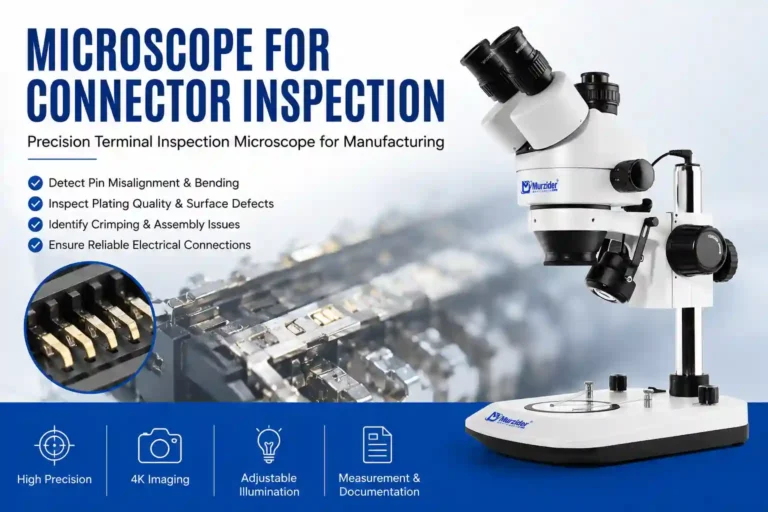
Similarly, wiring harnesses and electrical connection systems require precise inspection to ensure reliability and safety. A dedicated Connector Inspection Microscope helps manufacturers identify bent pins, plating defects, terminal damage, and assembly inconsistencies.
By integrating battery, EV component, and connector inspection processes, manufacturers can establish a comprehensive quality control system throughout the entire production chain.
Why Microscopy Matters in New Energy Manufacturing
As battery technologies evolve and energy densities increase, quality requirements continue to become more stringent.
Microscopy provides several important advantages:
- Earlier defect detection
- Improved production consistency
- Reduced warranty costs
- Enhanced product reliability
- Better process optimization
- Improved product safety
- Better traceability and documentation
For manufacturers seeking long-term competitiveness, investing in professional inspection equipment is increasingly becoming a strategic necessity rather than an optional upgrade.
Choose the Right Microscope for Your Battery Production Line
Selecting the ideal battery inspection microscope depends on several factors:
Inspection Target
Different applications require different microscope configurations. Electrode inspection may require different optics than welding inspection or final assembly verification.
Magnification Requirements
Understanding the difference between magnification and image quality is critical. Read our guide on Magnification vs Resolution.
The required magnification depends on the size of the defects being inspected and the level of detail required.

Working Distance
Production-line inspection often benefits from larger working distances that allow operators to manipulate samples during observation.
Documentation Needs
Manufacturers that require traceability may benefit from integrated digital imaging and measurement capabilities.
Future Expansion
Choosing a scalable inspection platform helps accommodate future production upgrades and changing inspection requirements.
Murzider provides customized microscopy solutions designed for lithium battery manufacturers, EV component suppliers, and industrial quality control applications. Our team can help identify the most suitable inspection system based on your production process and inspection objectives.
Conclusion
As battery quality requirements continue to increase, choosing the right battery inspection microscope is essential for ensuring product reliability, production efficiency, and safety. From defect detection to quality control, professional microscopy solutions help manufacturers maintain consistent standards throughout the entire production process.
At Murzider, we provide advanced microscopy solutions for lithium battery inspection, EV component testing, and industrial quality control. Whether for production lines or R&D laboratories, our microscopes are designed to deliver clear imaging, reliable performance, and efficient inspection workflows.
Need help selecting the right microscope for your battery inspection application? Explore Murzider’s professional microscopy solutions or contact our team for expert guidance.
Frequently Asked Questions
Most lithium battery manufacturers use stereo microscopes, digital microscopes, or industrial inspection microscopes depending on the inspection stage. Stereo microscopes are particularly popular because they provide excellent depth perception and working distance.
A battery inspection microscope can detect scratches, cracks, contamination, coating defects, welding defects, separator damage, assembly errors, and other microscopic quality issues that may affect battery performance or safety.
Most battery inspection applications require magnifications between 10X and 80X. Higher magnification may be used for detailed defect analysis or laboratory research.
Yes. Digital microscopes are widely used for battery quality control because they provide image capture, measurement functions, defect documentation, and easy collaboration between inspection teams.
Microscopic inspection helps identify defects that are invisible to the naked eye. Early defect detection improves product quality, reduces manufacturing waste, enhances battery safety, and supports compliance with industry standards.
A dedicated battery inspection microscope is optimized for lithium battery manufacturing applications. It typically offers suitable magnification ranges, specialized lighting options, imaging capabilities, and ergonomic features designed specifically for production-line inspection workflows.
Yes. Stereo microscopes are widely used because they provide three-dimensional viewing, comfortable working distance, and excellent depth perception during inspection.
Most battery weld inspections are performed between 10X and 50X magnification, depending on weld size and inspection requirements.
Microscopic inspection helps identify defects that are invisible to the naked eye. Early defect detection improves product quality, reduces manufacturing waste, enhances battery safety, and supports compliance with industry standards.